
Trump Is the Problem—Obedience Is the Weapon

The last essay I wrote for this series, The Revolution Will Be Televised, was called Trump is the Problem—But the Problem is Bigger Than Trump.
In that essay, I wrote that Trump is not just offensive to democratic norms, he has actively degraded them. I stated that he is an authoritarian out of control, at home and abroad.
Trump is clearly the problem. Yet, as I said in that essay, the problem is bigger than Trump. Democracy in the U.S. has been hollowed out, and it’s been happening for decades. Now, we have reached a tipping point with Trump.
That we are at a tipping point with Trump that could signal the end of democracy in the U.S. is no longer debatable. The violence, the corruption, the authoritarian signaling, the erosion of democratic norms—these are not abstractions. They are real, and they are happening now. People are being harmed. Institutions are being bent. The ground is shifting under our feet.
But as I stated above, the problem is bigger than Trump, because he does not rule alone.
He rules because obedience makes his power feel inevitable.
This is the part that is harder to look at, because it implicates more than Trump. It implicates systems. It implicates institutions. And it implicates ordinary people who do not see themselves as collaborators, because they do not experience themselves as cruel.
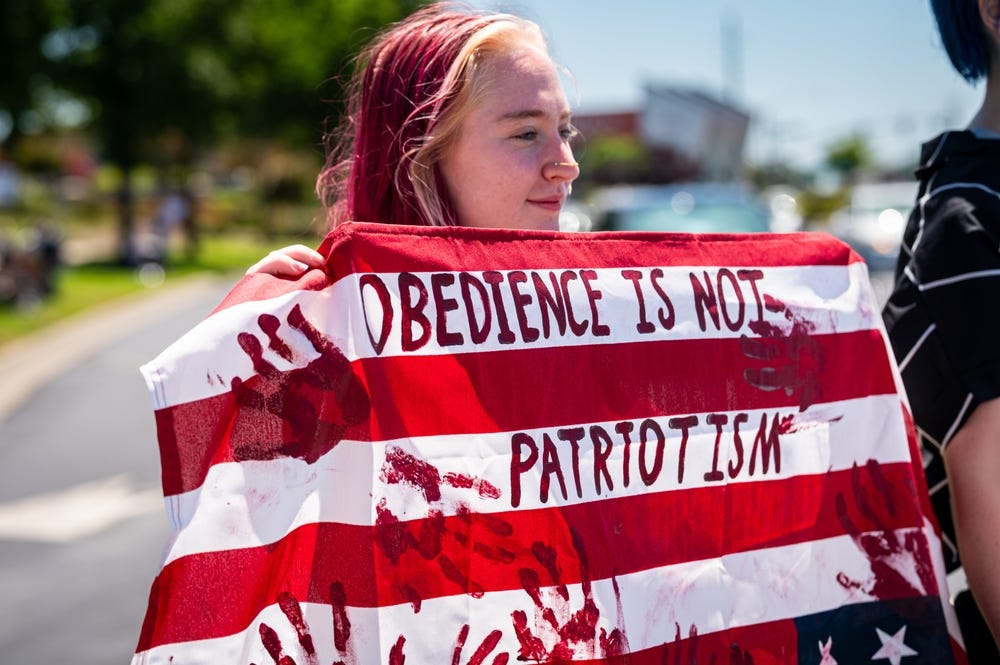
Trump’s greatest weapon is not rage. It is not spectacle. It is not even violence. It is obedience.
Violence comes later—when obedience begins to fray.
How authoritarian power actually works
Authoritarianism is often imagined as force imposed from above: soldiers in the streets, mass arrests, overt repression. But that image is misleading. By the time overt force appears, most of the psychological work has already been done.
Power does not begin with violence — it begins with compliance.
Orders are followed. Norms are bent. Exceptions are justified. Silence becomes habit.
Trump did not invent this mechanism. He has simply learned how to activate it at scale.
His genius—if it can be called that—lies in understanding that most people do not need to be terrorized to comply. They only need authority to feel legitimate, responsibility to feel diffuse, and dissent to feel isolating.
This is not new.
As I wrote about in the essay Why Do People Obey?, Stanley Milgram, through his Obedience to Authority experiments, showed us this decades ago.
What Milgram actually revealed
Milgram did not discover cruelty. He discovered compliance.
Ordinary people, placed in a situation where authority was framed as legitimate and responsibility was displaced, were willing to cause harm—not because they were sadistic, but because they believed they were not the ones ultimately responsible.
They were “just following instructions.” They were “doing their job.” They were “not the ones making the decisions.”
Milgram’s experiment is so disturbing precisely because it does not require monsters. It requires structure, authority, and permission. His experiments showed precisely why what Hannah Arendt called “the banality of evil” manifests.
Trump’s power operates in exactly this space.
Obedience before violence
Consider what happens before force is used: before federal agents kill protesters, orders are written. Before crackdowns occur, policies are approved. Before abuses are justified, language is softened. Before norms are broken, exceptions are normalized.
Each step feels small. Reasonable. Procedural.
No single actor feels responsible for the outcome.
This is why violence, when it comes, is always explained after the fact. It is never framed as the product of a chain of obedience. It is framed as an anomaly, a tragedy, a misunderstanding—anything but the logical conclusion of compliance.
Trump benefits from this diffusion of responsibility. He does not need to issue explicit commands for brutality. He only needs to create an environment in which aggression is rewarded, restraint is mocked, and accountability is unlikely.
Obedience does the rest.
Institutional obedience
Trump’s power is sustained first and foremost by institutional obedience: legislators who refuse oversight. Courts that delay rather than deter. Agencies that follow unlawful or unethical directives because “that’s the process.” And officials who stay in their roles to “do what good they can,” even as they normalize harm.
Each act is defensible in isolation. Together, they form a system that functions without conscience.
This is how democratic institutions are hollowed out from within—not through coups, but through compliance.
Media obedience
Trump also relies on media obedience: not silence—coverage. Endless repetition. False equivalency. Normalization of extremism as “controversy.” The treatment of authoritarian threats as mere rhetoric.
This obedience is not ideological loyalty. It is professional habit, commercial pressure, and fear of losing access. But the effect is the same: Trump’s behavior is framed as familiar, survivable, manageable.
Authoritarianism thrives when it is treated as background noise.
Civic obedience
Finally, there is civic obedience—the most uncomfortable category.
This is not about Trump’s supporters alone. It is about everyone who adapts.
People who disengage because it is exhausting.
People who stop paying attention to preserve their sanity.
People who tell themselves “this is just politics now.”
People who wait for institutions to fix what institutions are failing to confront.
This obedience does not feel like obedience. It feels like coping.
But authoritarian systems depend on this quiet adaptation. They depend on people recalibrating their expectations downward, normalizing what once would have been intolerable.
This is how democracy erodes without a single dramatic moment.
Why violence appears when it does
Violence is not the foundation of authoritarian power. It is the enforcement mechanism.
Force appears when obedience weakens—when protests grow, when legitimacy erodes, when people begin to refuse.
This is why repression often intensifies after dissent becomes visible, as we currently see in Minneapolis. Violence is not a sign of strength. It is a sign that obedience can no longer be taken for granted.
Trump’s willingness to tolerate—or excuse—state violence is not incidental. It is the final layer of a system that has already trained people to comply.
Why obedience is so hard to break
Obedience persists not because people are stupid or immoral, but because it is costly to resist.
Resistance carries:
professional risk
social isolation
legal uncertainty
emotional exhaustion
Obedience offers safety, belonging, and the illusion of normalcy.
Stanley Milgram understood this. So did every successful authoritarian movement in history. The question is never “why do people obey?” The question is “what makes disobedience feel possible?”
The pivot we cannot avoid
This is where the argument turns forward. If Trump is the problem, and obedience is the weapon, then the antidote is not outrage alone. It is the withdrawal of obedience.
Not chaos. Not violence. Not heroics.
Withdrawal.
Refusal to normalize. Refusal to comply with illegitimate authority. Refusal to displace responsibility. Refusal to pretend that silence is neutrality.
This is not abstract theory. It is the practical logic of nonviolent resistance.
Gene Sharp understood this clearly: political power depends on human obedience. Withdraw that obedience, and even the strongest regimes collapse.
Why this matters now
Removing Trump from power is necessary. Harm reduction matters. Lives depend on it.
But removing Trump without confronting obedience only delays recurrence.
The deeper work—the work that follows elections and court rulings—is psychological and structural. It’s about rebuilding institutions that reward conscience over compliance, cultures that value participation over passivity, and economies that do not turn fear into obedience.
Trump is the problem. But obedience is the weapon that makes him dangerous.
And until that weapon is disarmed, the face of authoritarianism may change—but the threat will remain.
What comes next
The next step is to return—explicitly and deliberately—to Stanley Milgram and the understanding of obedience, and also to delve into the conditions under which people refuse.
Because once we understand how obedience works, we can begin to understand how it ends. And that’s where real democratic power begins.
Authoritarian systems appear solid until the moment obedience falters. Power does not reside solely in leaders, laws, or institutions, but in the daily acts of compliance that sustain them. When those acts stop — quietly, collectively, or suddenly — power collapses faster than it was built.
This essay is part of a theme I’ll be writing several essays about in The Revolution Will Be Televised series examining how obedience — not just leaders — sustains authoritarian power. The series moves from obedience itself (“Trump Is the Problem — Obedience Is the Weapon”), to the systems that manufacture compliance, to the cult-like psychology that captures conscience, and then toward the forces that break the spell: resistance, refusal, and the collective withdrawal of consent. Power does not disappear when exposed. It disappears when obedience ends.