
Trump is the Problem--But the Problem is Bigger Than Trump

The last essay I wrote for this series, The Revolution Will Be Televised, was called Why Do People Obey, and was about the 1960s experiments by Stanley Milgram that he called Obedience to Authority.
Today, with this essay, I want to zoom out to look at what just happened in Minneapolis, and what that tells us about what needs to be done to turn things around.
[Please note: This series, The Revolution Will Be Televised, is an outgrowth of my feature documentary film, How to Save Democracy. I created this series because, when I screen the film, people invariably ask me after the film ends, What actions can we take to get to that place that you show in your film that saves democracy? This series answers that question.]
Alex Jeffrey Pretti
On January 24, 2026, federal agents killed another person in Minneapolis.
His name was Alex Jeffrey Pretti. He was an intensive care nurse—someone whose professional life was devoted to keeping people alive. He was killed during protests against an escalating Department of Homeland Security enforcement operation in the city, just weeks after Renée Nicole Good was shot and killed by an ICE officer in the same metropolitan area.
Two deaths. Same city. Same federal apparatus.
As is the pattern, the details DHS is reporting are contradicted by the video evidence. It’s a pattern clear enough to state: federal agents operating aggressively in American cities, protest treated as provocation, dissent reframed as threat, and lethal force justified after the fact.
This is not random. It is not accidental. It is not detached from political leadership.
It is happening under a president who has repeatedly signaled—through rhetoric, policy, and example—that force is an acceptable response to resistance, that escalation is strength, and that restraint is weakness.
Donald Trump allows this, enables this, and gives the green light to it.
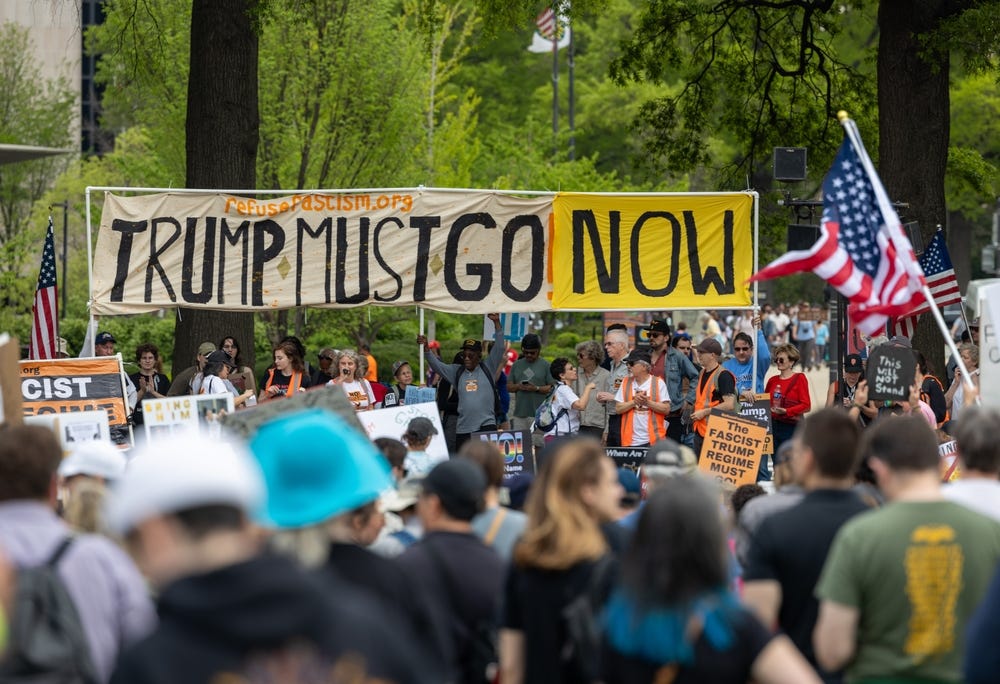
Trump is the problem.
Trump is the problem
Not symbolically. Not rhetorically.
Materially.
Trump is not merely offensive to democratic norms. He has actively degraded them. Under his leadership, federal power has been wielded less as a tool of public accountability than as an instrument of intimidation—against immigrants, against protesters, against cities and states that resist his authority.
When federal agents kill civilians during protests, that is not merely a failure of policing. It is a failure of governance. It reflects a political culture cultivated from the top down—one in which violence is normalized, accountability is deferred, and dissent is framed as disorder.
This is how modern authoritarianism advances: not in a single rupture, but through repetition. Each escalation is explained as necessary. Each abuse is isolated. Each death is tragic—but never disqualifying.
Trump is the problem because harm is no longer hypothetical.
It is happening now.
An authoritarian out of control—at home and abroad
Trump’s danger is not confined to domestic policy. It extends outward, revealing a broader authoritarian logic.
In recent times, Trump has openly threatened U.S. allies, suggesting that NATO protections are conditional and that military force could be used if other nations fail to comply with his demands. He has publicly entertained the idea of asserting control over Greenland, treating sovereign territory as if it were a negotiable asset.
Some of these statements have been walked back. Others dismissed as bluster. But this misunderstands how authoritarian power works.
Authoritarians test boundaries by saying what was previously unthinkable. The point is not always immediate action. The point is to see who objects, who complies, and who normalizes. Even when threats are withdrawn, the damage is done. The rules have been loosened. The unsayable has been said.
A democratic leader does not casually threaten allies. An authoritarian does.
Trump’s erratic coercion—domestic and international—is not strength. It is volatility weaponized as power. And when volatility governs, restraint erodes everywhere else.
Trump as accelerant
Trump did not invent American authoritarianism. But he has accelerated it relentlessly.
He has demonstrated:
that cruelty can be politically profitable
that corruption can be performed openly
that lying, repeated endlessly, can replace truth
that democratic norms exist only if someone enforces them
He stress-tests institutions not to strengthen them, but to expose their limits. He teaches followers that loyalty matters more than law, domination more than legitimacy.
Trump is not incidental to this moment. He is catalytic.
Removing the accelerant matters—because the fire is already burning.
Why the problem is bigger than Trump
And yet, as dangerous as Trump is, he is not the deepest threat.
The problem is bigger than Trump because Trump was made possible—and will be followed—by forces that do not disappear when he does. These forces are:
1. An oligarchic economy that hollowed out democracy
For decades, wealth and power have been extracted upward while democratic participation has been hollowed out. Entire communities were deindustrialized, unions dismantled, public goods privatized, and economic insecurity normalized. Politics stopped delivering material improvement and began offering scapegoats instead.
Trump did not create this betrayal. He exploited it.
When democracy fails to deliver dignity, people become susceptible to authoritarian promises of order, dominance, and revenge.
2. Institutions that bent long before they broke
Trump did not singlehandedly destroy democratic norms. He revealed how many were already unenforced:
Legislatures abdicated oversight
Courts delayed rather than deterred
Law enforcement applied standards unevenly
Media normalized extremism as “controversy”
Trump learned—correctly—that many institutions would not stop him if he pushed far enough. That lesson remains, with or without him.
The problem is bigger than Trump because impunity has already been modeled.
3. A propaganda ecosystem that trains obedience
Trump could not function without a media environment engineered for outrage and tribal loyalty.
Right-wing media did not merely defend him; it trained audiences to distrust all other sources of information. Social media platforms amplified disinformation because it drove engagement. Algorithms replaced editors. Rage replaced deliberation.
Trump did not build this system. He mastered it.
Remove Trump, and the infrastructure remains—waiting for the next figure capable of exploiting it.
4. Authoritarian habits that have already been learned
Perhaps Trump’s most lasting damage is cultural. He taught millions that:
cruelty is strength
compromise is weakness
enemies are internal
power should not be constrained
These habits have now spread beyond him—into state governments, school boards, courts, and law enforcement agencies.
The problem is bigger than Trump because authoritarian logic has been normalized.
5. A politics of permanent emergency
Trump thrives on crisis. But the crisis did not begin with him.
Americans have been kept in a constant state of fear—economic, cultural, racial, existential. Emergency politics suspends norms. It justifies force. It rewards strongmen.
Trump did not invent this politics. He perfected it.
If fear remains the organizing principle of public life, another Trump—possibly more disciplined—will emerge.
Why removing Trump still matters
Naming the larger problem does not minimize Trump’s danger. It clarifies it.
Trump is the immediate threat. Removing him — through the 25th amendment, impeachment, or other legal means — would reduce harm, save lives, and create breathing room. Democracies need that space to recover.
Removing Trump is not naïve optimism — it is necessary harm reduction.
But it is not sufficient.
Power and obedience
This is where both Gene Sharp and Stanley Milgram’s insights on obedience becomes clear and unavoidable.
Authoritarian power rests not only on force, but on obedience:
obedience of institutions
obedience of media
obedience of officials
obedience of citizens who normalize, comply, or look away
Trump did not rule alone. He ruled because enough people, at enough moments, complied.
Remove Trump without dismantling obedience, and the cycle repeats.
Holding the full truth
So we must say both things—clearly, without hedging:
Trump is the problem. But the problem is bigger than Trump.
Remove him because harm is real. Transform the system because harm will return if you don’t.
This is not contradiction. It is strategy.
What comes after Trump
The future of American democracy does not hinge on one man—no matter how destructive.
It hinges on whether people can:
withdraw obedience from illegitimate power
refuse normalization
rebuild institutions that distribute dignity instead of fear
imagine a society worth defending
Trump may be the face of the crisis. But the crisis is older, deeper, and more revealing.
And how we respond—after he is gone—will determine whether U.S. democracy survives, merely pauses, or continues its dystopian descent into fascism.