
Gene Sharp and the Blueprint for Nonviolent Revolution
The Hidden Architect Behind the Movements That Toppled Dictators — and Why His Work Matters More Than Ever Now

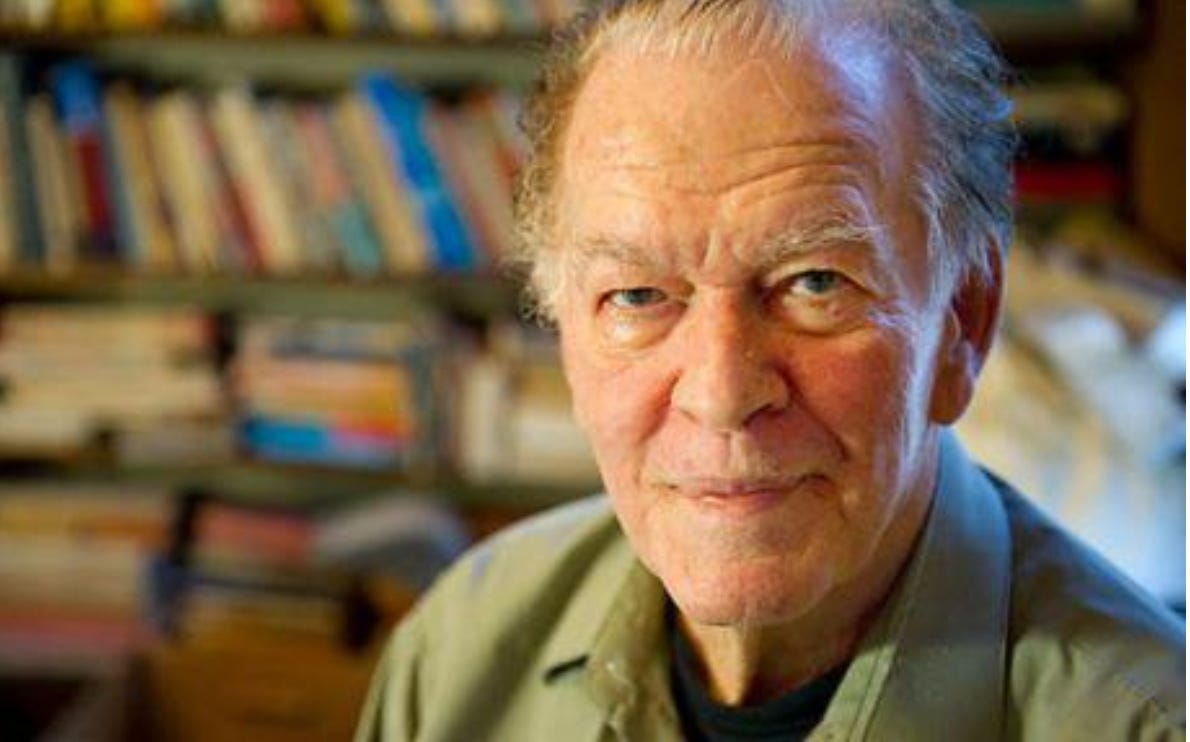
In my prior essay, The Anatomy of a Nonviolent Uprising, I briefly mentioned the work of the late Gene Sharp. Sharp, considered the world’s leading expert on nonviolent revolution, was nominated four times for the Nobel Peace Prize and was known for his extensive writings on nonviolent struggle, which have influenced numerous anti-government resistance movements around the world.
[Please note: This series, The Revolution Will Be Televised, is an outgrowth of my feature documentary film, How to Save Democracy. I created this series because, when I screen the film, people invariably ask me after the film ends, What actions can we take to get to that place that you show in your film that saves democracy? This series answers that question.]
In this essay, I thought I’d delve deeper into his work, so you can understand its significance and importance to our current time. Sharp’s ideas are as relevant now as they have ever been.
“We Use This Book As Our Scripture”
If you were standing in Tahrir Square in 2011—amid the chants, the banners, the makeshift field clinics, and the sea of humanity demanding the end of Hosni Mubarak’s 30-year rule—you might never have guessed that somewhere beneath the surface of that uprising lay a thin, modest book written by a soft-spoken scholar from Boston.
But in backpacks, photocopy shops, kitchen tables, and university dorm rooms across Cairo, activists had been quietly studying Gene Sharp’s From Dictatorship to Democracy, a small text translated into more than 30 languages and passed hand-to-hand in moments of political danger. One Egyptian activist put it simply:
“We use this book as our scripture.”
Serbian student organizers from Otpor!—who helped overthrow Slobodan Milošević—said the same. Burmese monks resisting military rule. Pro-democracy activists in Tunisia. Even Hong Kong students studied Gene Sharp’s principles.
And yet in the United States, where democracy is heading toward authoritarian capture, and where a rising oligarchic/kleptocratic class is stripping away guardrails once taken for granted, Gene Sharp remains almost unknown.
It’s time to bring him forward—because the revolution we need has already been mapped out.
The Man Who Treated Nonviolence as a Science
Gene Sharp did not begin as a strategist. He began as a conscientious objector during the Korean War, spending nine months in prison for refusing induction. But even then, the seed of his life’s work was planted. He wanted to know:
Why do people obey?
And how could they stop obeying—nonviolently?
Decades later, after earning a PhD at Oxford and founding the Albert Einstein Institution, Sharp would become the world’s leading theorist of nonviolent struggle. He wasn’t a mystic or a preacher. He didn’t argue from morality or spiritual tradition (though he respected those roots). Instead, he argued from power.
His core insight:
Political power depends on human obedience. Withdraw that obedience, and even the strongest regimes collapse.
Nonviolence, for Sharp, wasn’t passive. It wasn’t polite. It wasn’t the moral “nicer version” of protest.
It was strategic warfare—but without bullets.
Power Is Not What We Think It Is
The most revolutionary idea in Sharp’s work is also the simplest:
Power is not monolithic.
Even dictators rely on:
the cooperation of workers
the obedience of bureaucrats
the loyalty of police and military
the quiet compliance of the public
the economic participation of consumers
the legitimacy granted by institutions
And these, Sharp wrote, are all voluntary—even if people don’t always realize it.
If obedience is withdrawn—
when people stop showing up for work
when students boycott schools
when civil servants quietly refuse orders
when soldiers decline to fire
when the public floods streets in numbers too large to suppress—
the regime’s power base cracks.
Sharp identified six pillars of support for every oppressive system:
The military
Police and security forces
Civil administration
Judiciary
Media and propaganda organs
Business and economic elites
The task of a nonviolent movement is not to attack these pillars, but to undermine their willingness to support the regime.
He wrote:
“Obedience is at the heart of political power. And it is always conditional.”
Once you see this, you can never unsee it.
The 198 Methods: The Arsenal of Nonviolent Action
Sharp’s most famous contribution is his list of 198 methods of nonviolent action—everything from strikes, boycotts, walkouts, and mass resignations to public art, slowdowns, consumer noncooperation, workplace occupations, alternative institutions, symbolic funerals, and parallel governance.
The list is long for a reason:
Nonviolent struggle is a game of creativity, disruption, and persistence.
Movements win not by overpowering the state but by making it ungovernable—politically, economically, administratively, and psychologically.
That is the essence of the revolutions he helped inspire.
And it’s where the U.S. finds itself now: facing a system captured by oligarchs, extremists, and those who fear democratic participation precisely because it threatens their power.
Case Studies: When Sharp’s Ideas Changed History
Serbia (2000): Students vs. a Dictator
The student group Otpor! read Sharp obsessively. They used humor, pranks, decentralized organizing, and relentless nonviolent discipline to undermine the pillars supporting Milošević. When elections were rigged, they shut down the country. Milošević resigned.
Tunisia & Egypt (2011)
Sharp’s book circulated widely. It helped activists conceptualize protest not as spontaneous outrage, but as a strategic sequence:
expose corruption
build parallel institutions
escalate disruption
withdraw obedience
fracture elite support
The strategy didn’t guarantee stable democracies afterward—but it toppled regimes once thought immovable.
Burma (late 1980s & 2000s)
Students, monks, and civil society groups used Sharp’s framework to challenge military rule, even under brutal repression.
Sudan (2019)
The Professionals Association deployed classic Sharp-style tactics: mass noncooperation, general strikes, disruption, and alternative governance networks.
Gene Sharp wasn’t the mind behind every revolution—but his ideas were often the invisible architecture beneath them.
Why Sharp Matters for America—Right Now
The United States is not Egypt, Serbia, or Burma. But the U.S. is facing its most serious democratic crisis since the 1930s:
A political party openly embracing authoritarianism
Donald Trump’s continual attempts to consolidate power and rule as a strongman
A right-wing long game that has captured courts, legislatures, and regulatory bodies
Wealth inequality on par with the Gilded Age
Democratic institutions weakened by decades of privatization and deregulation
Widespread disillusionment with government
Oligarchs using money creation, financialization, and tax havens to reshape society
In this context, Sharp’s ideas land with startling clarity: Violence will not save democracy. But strategic nonviolence can.
Sharp offers the one thing the U.S. movement landscape desperately needs:
A strategy.
A playbook.
A map.
Sharp’s Lessons for the Present U.S. Moment
Lesson 1: Don’t waste time convincing politicians. Convince their power base.
Nonviolent movements succeed when they persuade the pillars—workers, civil servants, business leaders, judges, police, media institutions—that support for authoritarianism is untenable.
Lesson 2: Focus on maintaining nonviolent discipline.
Authoritarians want violence. It gives them justification to unleash the machine. Nonviolence forces them to reveal their true face.
Lesson 3: Create parallel institutions.
Participatory democracy, public banks, community councils, mutual aid networks, citizen assemblies: these are not side projects; instead, they are seeds of a new system.
Lesson 4: Withdraw cooperation, not just shout slogans.
Marches raise awareness. But noncooperation collapses power structures.
Lesson 5: Understand the long game.
Sharp always insisted that nonviolent struggle is complex, slow, and cumulative. It requires planning, training, unity, and organization.
The Revolution Will Not Start from Scratch—It Has a Blueprint
We are not inventing something new, nor are we stumbling in the dark — the strategy for democratic renewal has already been articulated with extraordinary clarity.
Gene Sharp handed us the blueprint for nonviolent revolution. Our task is to apply it to the specific crisis of American democracy.
In a moment when the United States is moving rapidly toward authoritarianism—backed by oligarchic wealth, minority rule, and institutional capture—Sharp’s insights are not obscure academic theories. They are emergency instructions for how a people can reclaim their power without succumbing to violence, despair, or chaos.
The revolution we need is nonviolent — Sharp has already shown how it begins.
The rest is up to us.