
Manufacturing Obedience
How Modern Media, Propaganda, and Disinformation Train People to Comply

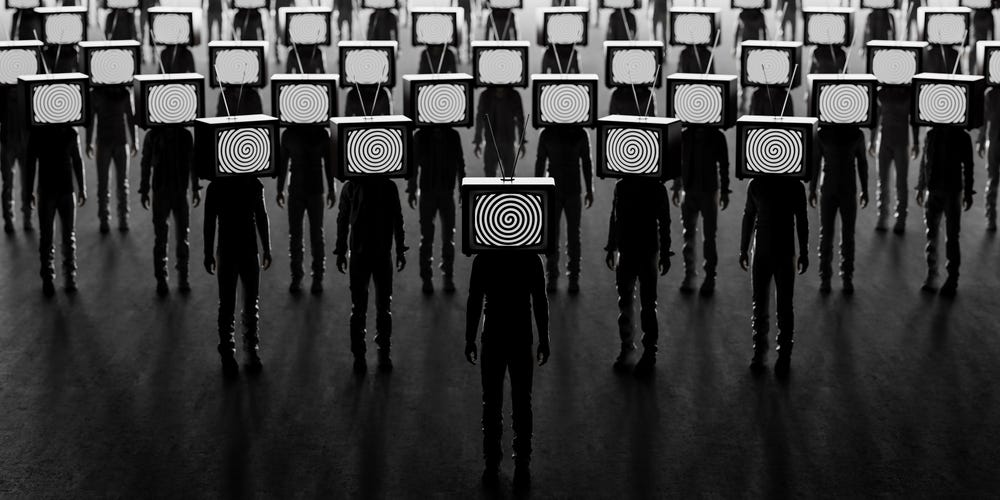
I’ve been talking in the last few essays about obedience, and referring to Stanley Milgram’s Obedience to Authority experiments to help you understand the mechanism of obedience. I specifically discussed this in the essays Why Do People Obey? and Trump is the Problem — Obedience is the Weapon.
I’ve brought up the subject of obedience in this series, The Revolution Will Be Televised, because of the work of Gene Sharp, who was the world’s foremost authority on nonviolent revolution. As I said in my essays on Sharp, he understood a core concept of how authoritarians are able to keep power. His insight was this: Political power depends on human obedience. Withdraw that obedience, and even the strongest regimes collapse.
[Please note: This series, The Revolution Will Be Televised, is an outgrowth of my feature documentary film, How to Save Democracy. I created this series because, when I screen the film, people invariably ask me after the film ends, What actions can we take to get to that place that you show in your film that saves democracy? This series answers that question.]
The Manufacture of Obedience
In this essay, I want to talk about how obedience is manufactured. I’ll start by again referring to Stanley Milgram’s experiments on obedience to authority.
You see, Milgram’s volunteers did not imagine themselves capable of cruelty.
They were ordinary Americans—polite, conscientious, eager to do the right thing. They came to Yale because Yale meant something. They trusted the man in the lab coat. They trusted the language of science, progress, and expertise. When they hesitated, when their voices cracked, when they asked if they should stop, the authority figure did not shout or threaten.
He reassured them.
Please continue.
The experiment requires that you go on.
You have no other choice.
And so they did.
Milgram did not uncover a hidden sadism in the American psyche. He uncovered something far more dangerous: the ease with which conscience can be relieved of duty when authority provides a convincing story. Obedience, he showed us, is not about hatred. It is about permission. About context. About the slow silencing of the inner voice that asks, Is this right?
The experiment ended more than sixty years ago. The lesson did not.
Today, the lab coat has been replaced by a badge, a uniform, a podium bearing the seal of the state, a television studio bathed in red-white-and-blue light. The experiment no longer takes place in a university basement. It unfolds in public, relentlessly, inside a media environment that saturates our lives from morning until sleep.
When federal agents killed both Renee Good and Alex Pretti, we weren’t witnessing single acts of violence. We witnessed a trial of obedience. A test not just of the agent’s judgment, but of a nation’s willingness to accept the story that follows. The language chosen matters. The framing matters. The speed with which the narrative hardens matters.
The government claimed it was unavoidable, that the federal agents were just doing their job, and that in doing so, order was preserved.
And standing above it all, conducting the orchestra of distortion, is Donald Trump: a megalomaniac who revels in authoritarianism. A man who speaks of power as possession, of institutions as toys, of violence as proof of strength. A man who understands—viscerally, instinctively—what Milgram demonstrated under controlled conditions: if you control the story, you can control the conscience. And if you control the conscience, people who believe the official narrative will be obedient.
From Commands to Narratives
Stanley Milgram believed he was studying obedience to authority. What he was really studying was obedience to a narrative under pressure.
The narrative was simple and soothing: this is legitimate; this is necessary; the man in charge knows better than you. Once that frame was accepted, the shocks no longer felt like a personal moral choice. Responsibility had been transferred—upward, outward, away.
That same psychological transaction governs political life today, only now it operates at mass scale.
Modern obedience is not produced by barked orders. It is produced by story environments—by repetition, by selective emphasis, by the endless normalization of the unacceptable. Power no longer needs to demand compliance. It cultivates it.
When state violence occurs, the first battle is never over accountability. It is over meaning. And meaning is manufactured.
Trump and the Machinery of Normalization
Trump rules like a showman intoxicated by dominance. He understands that in the age of spectacle, power must be performed. Lies need not be precise. They only need to be loud, constant, and emotionally charged.
Trump’s diabolical genius is his intuitive grasp of Milgram’s lesson: obedience does not require belief. It requires confusion, fatigue, and fear of standing alone.
Each outrageous claim shifts the boundary of the imaginable.
Each lie repeated becomes background noise.
Each act of cruelty reframed as necessity becomes precedent.
When Trump talks casually about seizing land, threatening force, or bending the law to his will, he is not floating policy ideas. He is training an audience. Training them to accept domination as realism. To mistake brutality for strength. To see obedience as patriotism.
The lab coat has become a red tie and a microphone. The effect is the same.
Fox News, Propaganda, and the New Experimenters
In Milgram’s study, the experimenter’s calm tone mattered as much as his authority. He normalized harm.
Today, that role is played by a tightly aligned propaganda ecosystem—most notably right-wing media outlets like Fox News and its imitators. These networks do not merely report events. They script reality. They pre-digest outrage. They launder state violence through the language of threat, chaos, and necessity.
Night after night, viewers are taught who to fear, who to dehumanize, and whose suffering doesn’t count. Migrants become invaders. Protesters become criminals. Victims become suspects.
And when official voices join the chorus—when Trump’s spokespeople, figures like Kristi Noem and Stephen Miller, step forward and lie through their teeth in order to defend, excuse, or obscure acts of state violence—the experiment reaches its final stage. Authority reassures. Media amplifies. Responsibility evaporates.
This is not misinformation in the old sense. It is obedience training.
It’s right out of the pages of Orwell’s 1984.
The goal is not to persuade everyone of the same lie. The goal is to exhaust the public until truth feels unreachable and resistance feels futile.
Confusion is not a failure of the system. It is the system.
Obedience Without Faith
One of the most disturbing aspects of Milgram’s findings was that many participants expressed doubt—even anguish—while continuing to comply. They did not believe what they were doing was right. They simply felt they were not allowed to stop.
That dynamic defines our political moment.
People repeat narratives they half-doubt.
They remain silent about injustices they recognize.
They accept explanations they know are thin because challenging them feels dangerous, exhausting, or isolating.
Obedience no longer requires conviction. It requires acquiescence.
Trump thrives in this environment. His lies do not need coherence. They only need velocity. Each repetition dulls resistance. Each day without consequence teaches the same lesson Milgram taught his subjects: someone else is responsible.
And all Trump has to do to achieve this is, as Steve Bannon put it, “flood the zone with shit.”
“Just Following the Narrative”
During the Nuremberg Trials that prosecuted Nazi officials, the common defense of those who stood trial was, I was just following orders.
Today, the language is softer—and more insidious.
I’m just reporting what was said.
I don’t know what really happened.
I never saw it.
It’s complicated.
Both sides are extreme.
These phrases sound reasonable. They are not. They are the grammar of moral surrender.
The danger is not that people become cruel. It is that they become spectators—watching democratic decay and state violence as if these were a sporting match rather than deliberate human choices.
Milgram showed us how responsibility can be displaced. Our media system has perfected that displacement at scale.
Why This Moment Is a Threshold
We are living through another obedience test. The killings of Renee Good and Alex Pretti are not aberrations. They are mirrors. They ask whether we will accept narratives that excuse violence in the name of order. Whether we will allow a megalomaniac and his enablers to define reality through repetition. Whether we will confuse authority with legitimacy.
Stanley Milgram warned us that ordinary people, placed in the wrong context, can commit extraordinary harm. But he also revealed something else, often overlooked: obedience is conditional. It depends on belief, trust, and participation.
And what depends on participation can be withdrawn.
History does not turn when people suddenly become heroic. It turns when they stop cooperating with lies. When they refuse to play their assigned roles. When obedience—quiet, habitual, taken for granted—begins to crack.
That withdrawal does not begin with force. It begins with recognition.
It begins, as Gene Sharp told us, when people remember that power only functions because it is obeyed.
And that obedience, once withdrawn—patiently, collectively, deliberately—has brought empires to their knees before.
And so, remember this: the power to transform society is in our hands.
Great essay. Obedience is also a necessary hallmark of militarism. Every army or battalion and every war depends on obedience to function. Fear or doubt are not permitted. That miltarism ha carried over to our whole society, and still predominates.