
Enshittification and Billionaire Media Capture
How the digital commons was captured—and how the system tightened its grip

I’ve been writing about the Enclosure Movement, then and now, because the Enclosure Movement explains a lot about how we got to the mess we are in now. Especially now, when we are experiencing a second Gilded Age in which wealth inequality is even more extreme than it was during the first Gilded Age.
The essays I have written about the Enclosure Movement are The Enclosure of Life and From Fences to Paywalls. I also wrote a satirical essay that parodied the world of influencers (who are a byproduct of the enclosure of the internet) called The Cat With Two Passive Incomes.
The Promise of the Internet
At first it felt liberating, like the promise of a spring day. It was the opening of the internet, and it felt like it was going to make the world better. Information moved without friction, voices multiplied, and gatekeepers weakened.
For a moment, it seemed the Commons had returned. Then something shifted. At first, gradually, and then predictably.
The Pattern
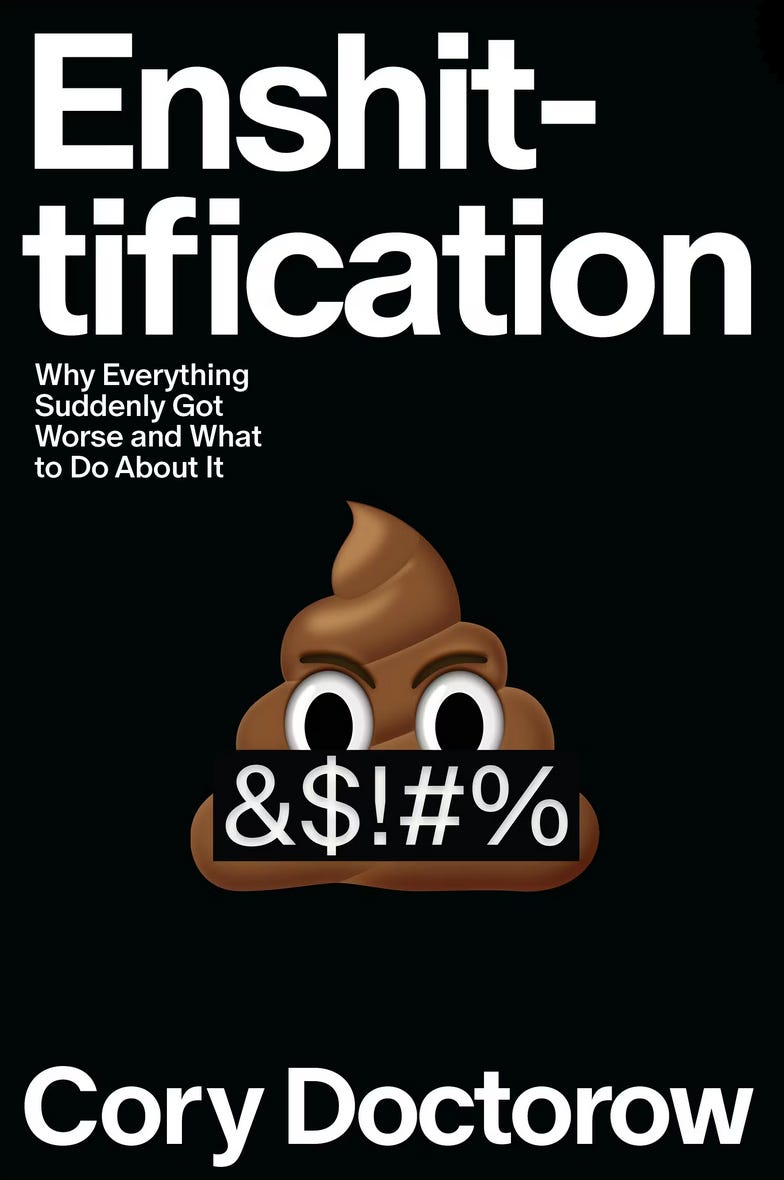
The writer Cory Doctorow calls it: Enshittification.
Platforms begin by serving users, and in the process, reels them in. Then advertisers come on board. The final party to the experience are the shareholders. And at each step along the way, the experience degrades.
Users and creators are squeezed. Then choice narrows. And ultimately, quality declines.
What began as a Commons has become a marketplace, and this marketplace has transformed into a machine, optimized for profits.
The Feeling of Decay
Go on the internet now and you can feel it: search worsens, feeds grow noisy, and ads multiply.
Nothing disappears outright. Everything remains; it’s just degraded.
That’s the trick. Enshittification doesn’t remove access. It reshapes it.
[Please note: The themes explored in this series, The Revolution Will Be Televised, are expanded on in my documentary, How to Save Democracy, which is now available to stream on Fandango at Home and Vimeo on Demand, along with cable on demand if you have Cox or Comcast as your cable providers. You can also buy it on Amazon. In the spring it will be available for universities and library patrons through Kanopy.]
The Capture
The early internet felt open. But open systems can be manipulated by being mapped. Once mapped, systems can be owned. And once owned, systems are optimized for the benefit of the owners.
Platforms quickly learned: If you control the interface, you control behavior, and if you control behavior, you control value. From there, an endless faucet of money pours their way.
And that’s how it’s done: the user became the product. The product became the data. And the data became power.
The Invisible Fence
This enclosure doesn’t announce itself. There’s no gate. No wall. No warning. There’s only friction, controlled by an algorithm that allows some voices to rise and others to disappear. Meanwhile, you, the user, are guided, ranked, and filtered.
The fence is not around the field. It is inside it.
The Megaphone
As platforms degrade, ownership concentrates, and as that happens, the narrative follows.
What we are seeing now is a small number of billionaires controlling a growing share of the infrastructure that defines reality. The latest is David Ellison, owner of Skydance Media, first buying Paramount, which is home to CBS/CBS News, and now on track to buy Warner Bros. Discover, home to CNN.
This is not loud censorship—it’s alignment. The owners shape the incentives, the incentives shape coverage, and the coverage shapes perception.
The system tilts in the direction of billionaire capture. And over time, the range of what can be seen—and said—narrows.
The Closed Loop
This is where we’re at: platforms shape attention, media shapes narrative, narrative shapes belief, and belief shapes behavior.
And now, we’re in the next phase of the loop: AI, which creates systems that produce knowledge.
The Enshittification of Intelligence
So now the pattern extends again, into knowledge itself. At first, these new AI systems felt liberating, accessible, powerful, and expansive.
It’s the same thing we said about the internet. But AI, like the internet, is built inside the same incentives. And so the pattern continues:
Access becomes enclosed and gated. Capabilities stratify. Dependence deepens. What feels like intelligence becomes interface. What feels like openness becomes mediation.
The Commons is absorbed and returned as a product. The question is no longer: What do these systems know?
It is: Who do they serve?
The System Converges
This is the current situation: platforms shape attention and media shapes narrative. And AI is shaping knowledge.
All of these—platforms, media, and AI—are no longer part of the Commons, or an aspect of the common good: all three are centralized, privately owned, and incentive-driven.
They form a self-reinforcing, self-optimizing loop for explicitly one purpose: for engagement and the rewards of engagement, namely profit.
The Return of the Lord
The economist Yanis Varoufakis offers another way to see it: what he calls technofeudalism.
He calls it that because he understands that platforms are not just companies competing in markets, but instead are digital estates. They’re spaces we don’t own, but must pass through.
Value is extracted through access. Rent replaces profit. Dependence replaces choice.
You don’t leave easily, because communication, visibility, knowledge, and livelihood now flow through these systems.
What looks like a marketplace begins to resemble something older: lords (the tech billionaires) and tenants (us), rebuilt in code. Hence the term technofeudalism.
The Political Consequence
Democracy depends on shared reality. Not perfect agreement, but shared ground. When platforms degrade, media consolidates, and knowledge systems centralize, that ground erodes.
It’s what we are seeing these days: the level of discourse descending, fragmenting and disintegrating, trust collapsing, and attention splintering.
People no longer argue within the same space. They exist in parallel ones, composed of separate realities, all created through manipulation.
As this takes place, democracy doesn’t disappear. Instead it transforms, from participation to performance. All because performance leads to more clicks, and more clicks leads to more money.
The Big Question
If attention, narrative, and knowledge are all privately controlled—can democracy survive inside systems designed for extraction?
What This Is
This is not a glitch. It’s the modern-day enclosure that, instead of fencing off land, has extended into attention, into narrative, into knowledge, and into reality itself.
The Break
Every enclosure depends on compliance and obedience, as Stanley Milgram and his Obedience to Authority experiments showed. But compliance and obedience can be withdrawn.
Not easily. Not instantly. But historically: no enclosure has been permanent.
The Bridge
The Commons has been captured by billionaires looking to make even more money. The question now is whether it can be reclaimed—or whether it will continue to degrade until nothing resembling a Commons remains.
That is not a technical question. It is a political one.
The Line
The promise of the internet, we were told, was that it would set us free. Instead, it has entrapped and contained us quietly, efficiently, and profitably.
The fence didn’t return as wood or wire. It returned as interface. As system. As something we move through every day without seeing the edges.
The fence is here. The only question is whether we recognize it before it finishes closing.
In the next, and final, essay on the Enclosure Movement, I will talk about how we can take the Commons back. This next essay is called Reclaiming the Commons: What It would mean to take back what was never meant to be owned.
this is exaclty the line of thinking and inquiry of my work at Common Planet. I look forward to your next one as it's near and dear to my heart. this is my answer for how we reclaim our commons: https://commonplanet.substack.com/p/the-creditism-evolution-from-debt
This essay does describe an unfortunate development of the internet. In days past, many of us considered it a possible asset to democracy in thought and education, a digital commons accessible to anyone with a computer.. Instead, it has contributed to a balkanization complete with paywalls and security excesses. I receive so many posts that express worthy plausible opinions and information, much of it overlapping, but many of these posts have a paywall extension. Why should I pay to learn someone's opinion, or even information I might obtain elsewhere? Monetizing public conversation feels unseemly, and as a matter of principle I have avoided paywalls. It is becoming more difficult to download items of interest as well.